

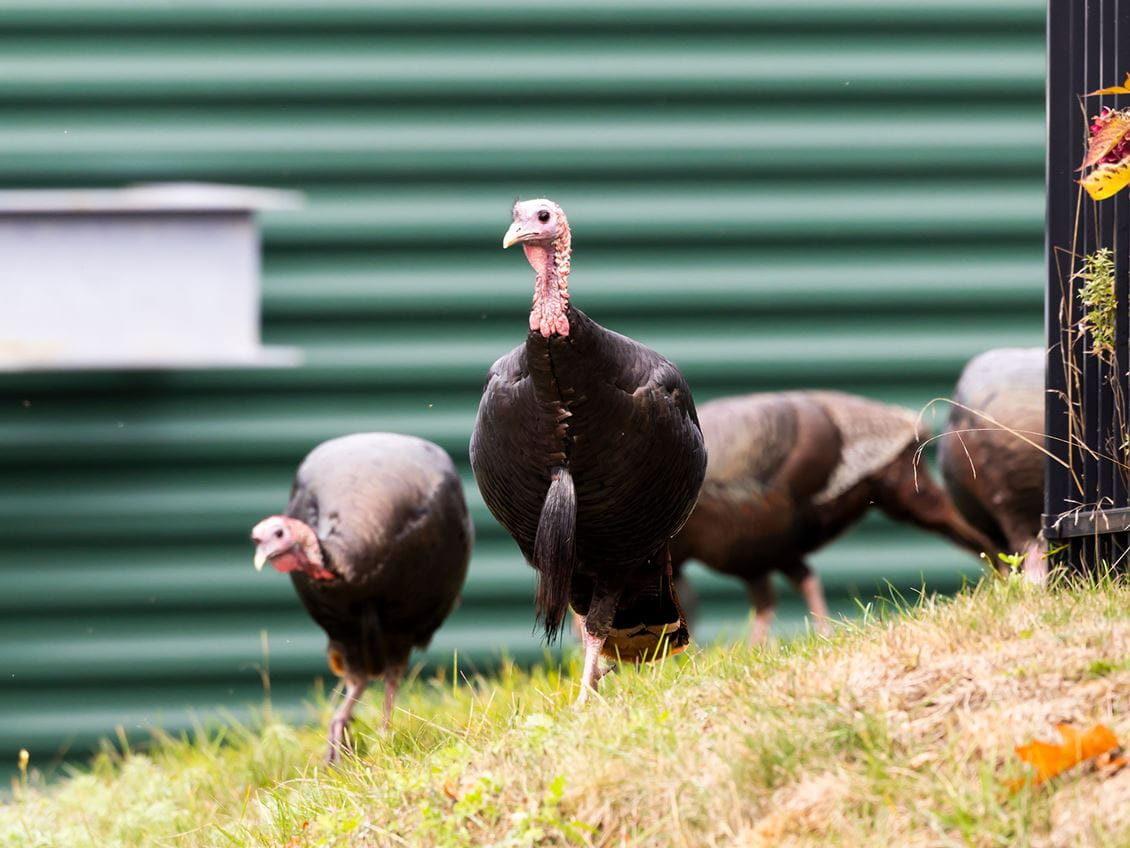
Endicott, home of the Gulls, geese, and … wild turkeys?
Yes, and the College isn’t alone. Across Massachusetts, these once-rare birds have staged a full-blown comeback—strutting down suburban streets, halting traffic, and, increasingly, sauntering across college campuses like they own the place.
At Endicott, sightings are common near the Bourque Arena, the lawns behind College Hall, and occasionally outside Callahan Dining Hall, where their confidence is, frankly, unmatched—especially during Thanksgiving week, when you’d think they’d be a little more discreet.
But how did the turkey—once nearly wiped out in New England—become one of the region’s most common and audacious residents? To find out, we turned to Associate Professor of Environmental Science Gordon Ober, who studies the ecology of our coastal campus and has a front-row seat to the Great Turkey Takeover.
How did we go from almost no turkeys in New England to “Oh look, seven turkeys are blocking my parking spot” levels of abundance?
Ober: Before European colonization, wild turkeys were pretty abundant in Massachusetts and all across New England. But as New England transformed after colonization, forests were cleared and replaced with agricultural land, resulting in significant habitat loss for wild turkeys. Turkeys were also over-hunted. As such, wild populations more or less disappeared from Massachusetts during the 19th century. In the 1970s, Massachusetts Wildlife facilitated a reintroduction program in which wild turkeys from New York state were trapped and brought to Massachusetts to help restart the population. Thirty-seven birds were released during this time, and today we have an estimated 30,000-35,000 turkeys! Their success is due in part to a few factors: better management (you need permits to hunt turkeys and are limited to how many can be taken), better access to resources (more on that later), and fewer natural predators (more on that later as well).
In short, this is an example of a successful reintroduction and conservation effort! Many rewilding or reintroduction efforts are not.
What does their growing presence say about suburban ecosystems … and should we be flattered they chose us?
Ober: Turkeys have done well in human-dominated environments. Where we have developed suburbs, we’ve pushed out turkey predators. There’s safety in the suburbs. There are also plentiful sources of food—many of us also put out bird seed, which becomes an easy-to-access source of food for turkeys. Edge habitats—those at the intersection of forests and open spaces—are ideal for turkeys. They can venture into open/grassy areas in search of food, but can also dip back into the forest for safety and protection.
Turkeys can be found in urban, suburban, and rural areas. Interestingly, wild turkey populations appear to be declining in rural areas but thriving in suburban and urban areas, primarily due to the factors mentioned above.
Is anything out there eating them anymore, or are cars their only true predator now?
Ober: Historically, things like coyotes, bobcats, and even fisher cats were the primary predators for turkeys, and they still are for wild turkeys living in more rural areas. But on campus, they have everything they need and nothing to fear!
What are your favorite “this is why turkeys are smarter than we give them credit for” facts?
Ober: There’s definitely more to turkeys than meets the eye. Turkeys can run pretty fast (around 20 mph!) and they are actually good flyers (up to 50 mph!).
Turkeys also wear their emotions on their sleeve—or face, rather. Their faces can turn from blue to red to white. The more intense the color, the stronger the feeling! They will have white or blue faces when calm, but will turn red when excited, scared, or worked up!
Turkeys can also reproduce via parthenogenesis, meaning females can lay eggs and create viable offspring with unfertilized eggs.
Turkeys have keen eyesight and can see in color, which makes sense, because why else would they change face colors if no one could tell?
Turkey poop can tell you the sex and age of the turkeys—males have J-shaped poop!
Speaking of which: Are turkeys actually kind of … brilliant? Are they the valedictorians of the campus bird hierarchy?
Ober: This is a tricky one; so many birds on campus. Geese are loud, messy, and only hang out part of the year (like freshmen?). Gulls are great at scavenging—I mean, does anything really beat the gull perched on top of Cally? Turkeys are awesome and likely underappreciated; they are fearless and proud. They are here even when they aren’t in our face.
What adaptations make them perfect Endicott students? (Strong legs for the stairs? The ability to find food anywhere? A flair for drama?)
Ober: Turkeys proudly strut their stuff, wear their emotions on their sleeve, and can survive the New England winters. They are adaptable and can handle a challenge. They cross the street without hesitation, making it hard to drive on campus (just like EC students!).
Do you see this turkey bubble bursting anytime soon?
Ober: Again, turkeys are doing pretty well in suburban and urban areas, but that doesn’t mean they aren’t without threats. Continued habitat loss and loss of forests removes key habitat for turkeys. Changes to climate conditions also make survival of young turkeys more difficult. But we have good management and conservation resources in the state that should continue to promote the survival of the species.
Do our turkey friends survive winter on grit alone? (Or is the down jacket legit enough?)
Ober: Turkeys will flock together during the winter. Under harsh conditions, turkeys slow down a bit to conserve energy, moving much less and seeking denser habitat for protection from the weather. They’ll still roam in their packs searching for food, and they are good at digging through the snow to find acorns and other food morsels. They will often seek out trees to roost in as well.
Turkeys have what’s called a countercurrent exchange in their leg, where blood vessels are close to one another and share heat; this means that colder blood gets to warm up on its way back to the core, saving the turkey some energy.
Finally, where are these majestic beings sleeping? Because they vanish at sundown like they have a curfew.
Ober: Turkeys like to head to the forests and will actually fly into the trees to sleep! This keeps them well protected from potential predators.