

When faculty in the Curtis L. Gerrish School of Business took a close look at their curriculum last year, they noticed something missing: a shared starting point for the approximately 200 first-year students who call the business school home.
This fall, a pilot first-year orientation program that blends community-building and hands-on learning has helped fill that role. It’s part welcome, part workshop, and part launchpad for the skills students will use throughout their journey at Endicott College. (While Endicott previously had a College-wide first-year experience, this is the first time the Gerrish School of Business has created its own just for business students.)
Spearheaded by Associate Professor Kristine Kelly, the first-year class is designed to be interactive and features guests from across campus to share their expertise.
“We had athletics coaches talk about stress and mindfulness, a former faculty member spoke on conflict resolution, and librarians shared information about resources they offer,” explained Professor Linda Robson, who has also been involved in planning. “There is a core committee that oversees a collection of content contributors, so we have buy-in from a variety of different people on campus.”
The class also solves a surprising challenge: Endicott’s celebrated model for small class sizes means students from the Gerrish School of Business, which now includes majors ranging from finance to healthcare management to events management, don’t often have chances to meet others outside their program. Though it might seem unwieldy to have a class of 200 students, it offers first-year students an opportunity to meet faculty and make new friends, building community across study areas.
International business and marketing dual major Meredith Stone said the experience made her first semester better.
“Being a freshman, not knowing anything about the College, having this class helped me gain knowledge about the school and get acclimated quickly,” she shared. “I was able to make connections with teachers in the business school, and it created a sense of community.”
The variety of topics helps ensure that each student gets exposure to ideas they might not otherwise have, as first-year student Ethan Norris ’29 did.
“I’ve become more interested in mastering time management; it has been crucial to help me find success this past semester,” he shared.
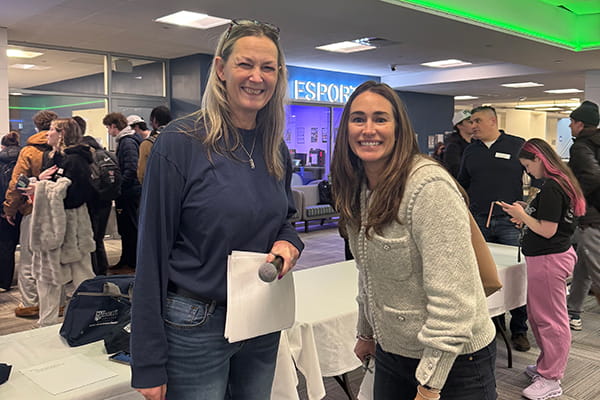
To bring the Experiential Edge to an experiential course, Robson teamed up with students from the group she advises, Endicott’s Events Management Organization (EMO), to design the final session on December 3. With a few EMO members already enrolled in the class, the collaboration became a natural bridge between extracurricular creativity and the first-year experience, letting students shape the course from the inside out.
Following EMO’s process means realizing that planning a class can be a lot more work than you’d imagine. From creating budgets and pitching ideas to leadership to fostering creativity and managing tight schedules, there’s a lot to keep track of.
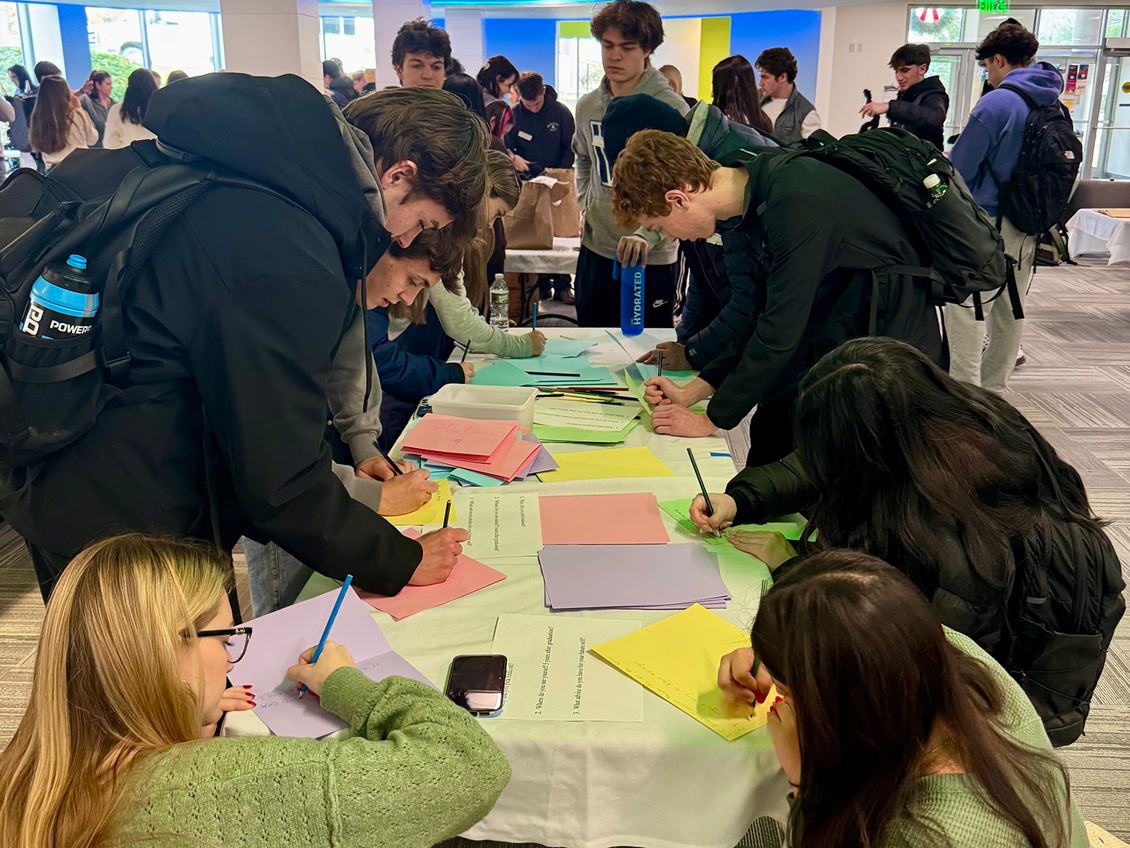
Their work culminated in a high-energy program in Lower Callahan, where 14 rapid-fire activity stations kept students moving every three minutes. They signed a Class of 2029 banner destined for the Gerrish School of Business hallway, made dog toys for a local animal shelter, and jumped into everything from oversized Jenga and Connect 4 to minute-to-win-it challenges. A raffle table featured prizes such as Gerrish School of Business merchandise, an iPad, and Beats headphones.
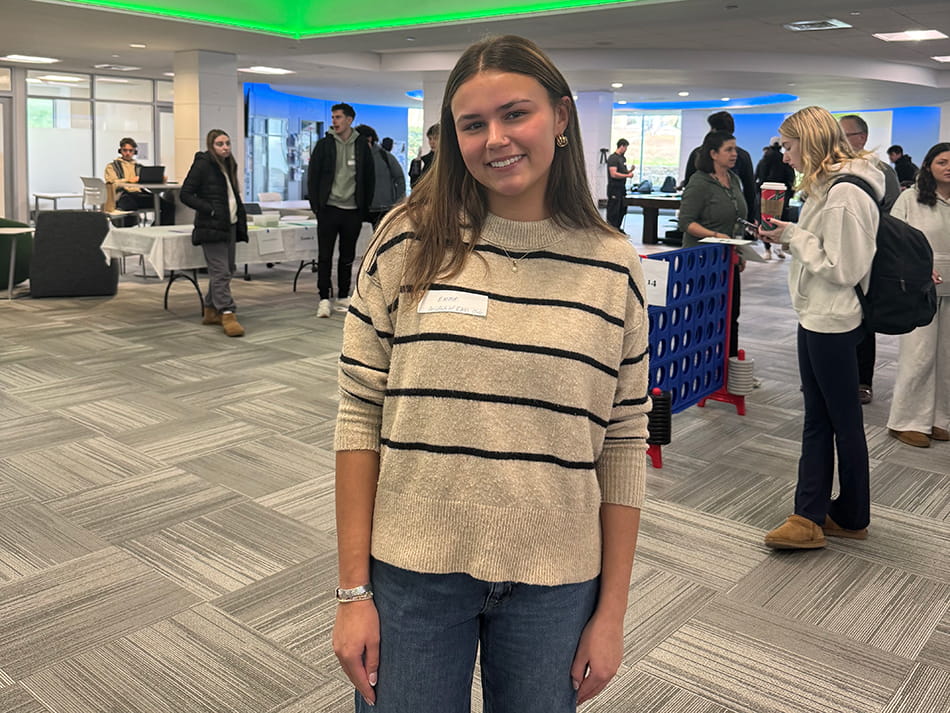
EMO president and events management major Emma Rutkiewicz ’27 said the event was well-received and enjoyable to plan and execute.
“It’s a great way for EMO to connect with the freshmen, and it allows the students to get more involved and close out the end of their first semester of college with a fun and engaging event,” Rutkiewicz shared.
Events management major and EMO vice president Grace Sullivan ’27 said she hopes the mix of thought-provoking and fun stations helped students feel engaged.
“I hope students left the class feeling like it was an active and social experience and that they felt more connected to the college and to each other,” she shared.
According to first-year business management major Emmy Carlson ’29, Sullivan’s hopes were realized.
“EMO clearly put in time and effort to make it an enjoyable last class,” she said.
Carlson added that having a mixture of faculty and students planning classes offers benefits.
“Students can come up with some fun ideas that faculty may not; however, faculty have a lot more experience that they can pass on to students,” she said.